
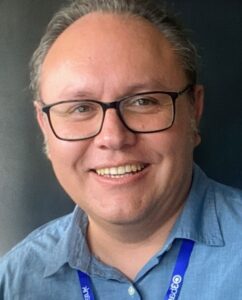
Research Biography
I am an Artificial Intelligence researcher specializing in Machine Learning and Data Science. My work focuses on the development of innovative machine learning techniques and the application of data science to solve complex, interdisciplinary problems across a wide range of sectors.
I have published over 40 works, including journals, book chapters, edited books, and conference proceedings. Additionally, I have supervised more than 15 theses and have held the SNII Level 1 distinction (National System of Researchers) since 2017.
Education
Postdoctoral Researcher, TecNM, 2016
Ph.D. in Computer Science, UABC, 2012–2016
M.Sc. in Computer Science, UABC, 2010–2011
B.S. in Computer Engineering, UABC, 2002–2007
Contact
mauricio.sanchez@uabc.edu.mx
Research interests
Artificial intelligence
Soft computing
Data science
Fussy logic systems
Intelligent embedded systems
Machine learning
Applications with artificial intelligence
Publications
SCOPUS:
https://www.scopus.com/authid/detail.uri?authorId=56757648300
GOOGLE SCHOLAR:
https://scholar.google.com.mx/citations?user=HSWet0cAAAAJ
ORCID ID:
orcid.org/0000-0002-7473-0546
RESEARCHGATE:
https://www.researchgate.net/profile/Mauricio_Sanchez7
Research projects
2025
Exploring new opportunities for the efficient application of Artificial Intelligence in problem-solving.
2023
Custom LLMs in local environments for academic tutoring applications.
2019
Predicting university student dropout rates using computational intelligence techniques based on academic trajectory data at the degree-program level.
An intelligent and ubiquitous platform to facilitate the development and teaching of interactive materials for preschool and elementary education.
2017
Utilizing intelligent computing to identify physiological and/or degenerative motor conditions via body-worn sensors.
2016
Granular computing techniques applied to body sensing for identifying physiological and/or motor conditions in older adults.
Thesis supervision
Ph.D. (Doctoral Level)
2025 – Present, Cristina Vargas Puente: “Quantum cryptography model applying machine learning to AES encryption and QKD enhancement.”
2025 – Present, Miguel de Jesús Chávez Hernández: “Development of a predictive and interpretive model of molecular interactions using natural language-guided AI agents, physicochemically validated through quantum calculations: Application in anesthetics and antihistamines.”
2024 – Present, Victor Manuel Bautista Mendoza: “Nonlinear multivariable speed controller for an Ackermann-type robot using a reinforcement learning observer with a type-2 fuzzy logic algorithm.”
2020 – 2025, Gustavo Omar Zamarrón de la Garza: “Reinforcement learning architecture for an intelligent agent capable of adapting to diverse virtual environments.”
2018 – 2023, Raul Ignacio Navarro Almanza: “Interpretable machine learning model using granular computing.”
2016 – 2022, Sukey Sayonara Nakasima López: “Intelligent fuzzy models for Big Data.”
Master’s Degree
2024 – Present, Aurelio Meza Estrada: “Optimization of arrhythmia detection using data science in electrocardiography.”
2024 – Present, Abraham Barajas Velázquez: “Identification of oncological biomarkers through machine learning and data science for personalized diagnosis.”
2022 – 2025, Miguel de Jesús Chávez Hernández: “Search model for potential compound pairs for the inhibition of the RAF-MEK-ERK signaling system for mitogen-activated kinases using machine learning and computational simulation.”
2021 – 2024, Ricardo Castro Gonzáles: “Design patterns for embedded systems applied to the Internet of Things (IoT).”
2021 – 2023, Leticia Sarahi Espinoza Barraza: “Design, control, and monitoring of smart gardens in confined spaces.”
2020 – 2025, Edgar Alberto Betancourt Juárez: “Motion capture system for a human arm based on inertial sensors for teleoperation.”
2020 – 2022, José Isabel García Rocha: “Mixed reality vision system for active motorcycle safety.”
2019 – 2021, María del Rosario Sánchez García: “Behavioral pattern analysis within a smart environment for the detection of atypical behaviors using Edge Computing.”
2017 – 2019, Osbel Alejandro Islas Silvas: “Intelligent algorithm to optimize the charging process of a Lithium Polymer (LiPo) battery.”
Bachelor’s Degree (Undergraduate)
2024 – 2025, Deysi Belen Rufino Ramos: “Evaluation of embedding techniques: Optimal selection for Large Language Models in various use cases.”
2019 – 2020, José Isabel García Rocha: “Granular computing techniques applying sensing.”
